
Wild Sleep

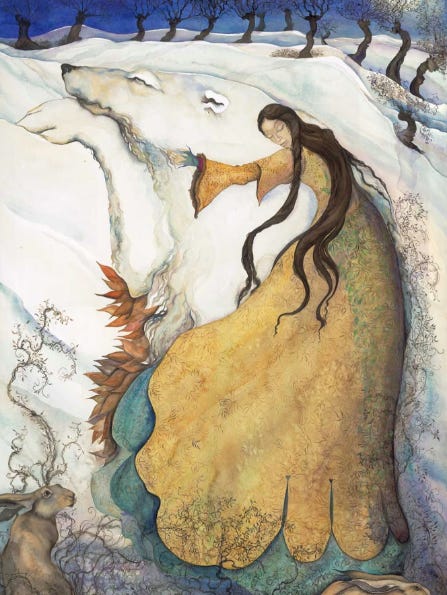
Winter. Some of us have an inclination towards hibernation, stillness. But it’s not necessarily a calm stillness: during this hibernation time, the imagination can go wild.
This poem below closely follows (but is not an exact translation of) a Herman Hesse poem and is translated/written by Charles Bernstein who sent the poem out in his holiday greetings email. Drowsiness becomes alive, more alive than wakefulness. The poem is counterintuitive in that it takes its life from celebrating the joy of tiredness, of drifting off…
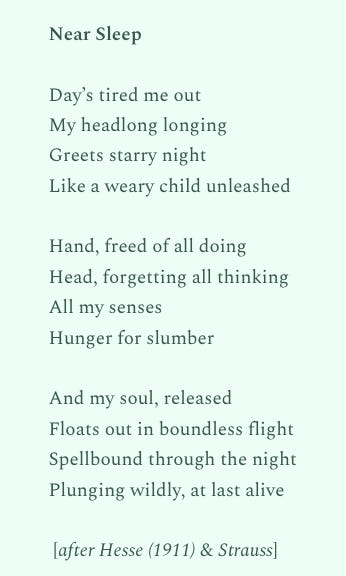
The poem reminds me of Keats’s “Ode to a Nightingale” where the speaker also longs to drift away (“fade away into the forest dim”) and wants to forget “all thinking” (“Where but to think is to be full of sorrow”). But where Keats’s poem is fuelled by depression (“My heart aches”), Hesse’s poem comes from a place of wild excitement.
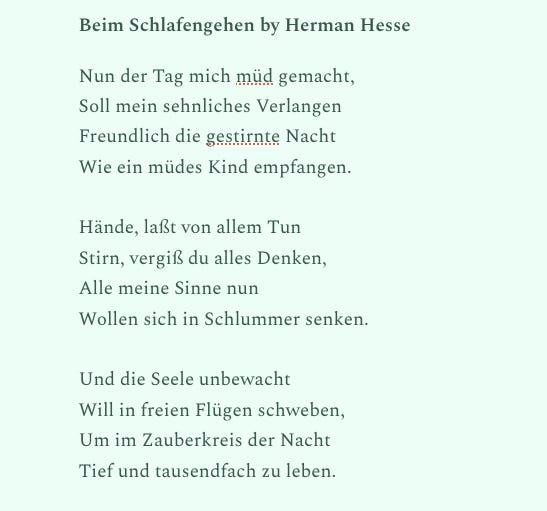
Here is the original German:
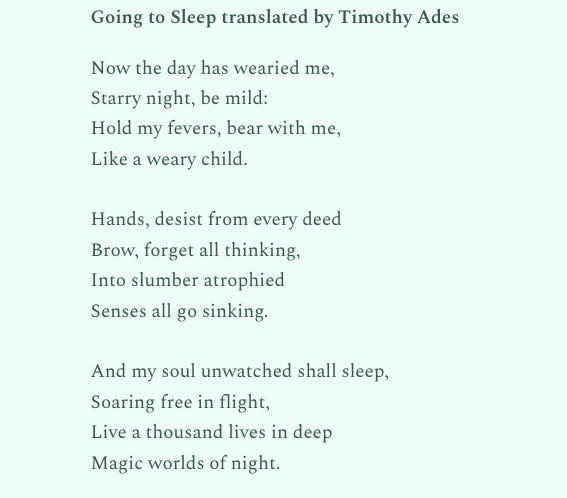
I was interested to find another translation of the poem, which honours the conventional rhyme scheme. The Bernstein includes rhymes but not in a conventional pattern. And the language in the Ades translation is less contemporary and more traditional:
Prompt: Write a poem that explores the experience of being “near sleep.” Experiment by using language that you wouldn’t normally find in a poem about drifting to sleep. See how the Bernstein translation uses words like “Released,” “hunger,” and “wildly.” Perhaps try using similar words one wouldn’t associate with drowsiness.
[painting: The Guardians: Sleeping with the White Bear, While the Wild Hares Keep Watch. by Jackie Morris]